
Homeowner Education
Homeowner Education and Long-Term Floor Care
Humidity control, cleaning, warning signs and maintenance to help a hardwood floor last a lifetime.
Wood flooring is one of the few building materials that can truly last the lifetime of a home. Unlike carpet, vinyl, or laminate, solid hardwood can be refinished multiple times, restored after decades of wear, and passed from one generation to the next.
But there is a condition. Wood is a natural, living material that responds to its environment. It expands, it contracts, it breathes. If homeowners do not understand how moisture and humidity affect their floors, even a perfectly installed floor can develop problems. This guide covers long-term care, with a focus on the role moisture plays in performance, appearance, and durability.
Why Homeowner Education Matters
Many wood floor problems are not installation failures, they are moisture management failures. Floors cup, boards crack, gaps appear, and sometimes floors buckle. Often the root cause is not poor craftsmanship but a misunderstanding of how wood behaves. When homeowners understand how humidity affects wood, which seasonal changes to expect, how to clean properly, which warning signs to watch for, and how HVAC systems influence floors, they can prevent serious damage and extend the life of the investment dramatically.
The Science: Wood and Moisture
The most important concept in long-term floor care is that wood is hygroscopic. It gains and loses moisture depending on the relative humidity and temperature of the air around it. When humidity rises, wood absorbs moisture and boards expand. When humidity drops, wood releases moisture and boards shrink. This continues for the entire life of the floor.
Equilibrium Moisture Content (EMC)
Every home has an equilibrium moisture content, the point where wood is balanced with the surrounding air. If flooring is installed at 8% moisture content but the home settles at conditions that support 12%, the boards will absorb moisture and expand. If it is installed at 10% in a home that averages 6%, the boards will shrink. That is why climate control and homeowner awareness are essential.
Common Moisture-Related Floor Conditions
Knowing these conditions helps you tell normal seasonal behavior from a serious problem.
Cracks between boards
Almost every wood floor shows some seasonal gapping. In winter, heating reduces indoor humidity, boards shrink, and small gaps appear. On standard 2¼-inch oak, cracks can reach about the thickness of a dime, and wider planks show more noticeable gaps. This is normal and usually temporary, because the boards expand and the gaps close as humidity rises in spring and summer.
Be concerned if gaps stay wide year-round, exceed typical seasonal expectations, or if splintering edges develop. The best prevention is to keep indoor humidity roughly between 30% and 50% year-round.
Cupping
Cupping happens when the edges of a board sit higher than the center. It usually points to a moisture imbalance, often from high indoor humidity, wet subfloors, plumbing leaks, crawl space moisture, or concrete slab emissions. Minor cupping can resolve naturally once moisture levels normalize. Severe cupping may require refinishing.
Crowning
Crowning is the opposite: the center of the board sits higher than the edges. It often occurs when a cupped floor is sanded too soon or when surface moisture is introduced repeatedly. It typically needs corrective sanding and refinishing after moisture has stabilized.
Buckling
Buckling is the most severe moisture reaction. The floor lifts away from the subfloor, and boards may rise several inches. It is rare and usually caused by flooding, long-term moisture intrusion, or a major plumbing failure. Sometimes sections can be repaired rather than replaced, but immediate action is required.
Sources of Moisture in Homes
Many homeowners assume moisture only comes from spills. In reality the sources are often hidden:
- Framing and subfloors in new construction: rain during building can trap moisture inside materials.
- Ground water: high water tables after storms raise subsurface moisture levels.
- Surface water: improper grading sends rainwater toward the foundation.
- Crawl spaces: poor ventilation leads to musty odors, mold near floor level, and condensation on windows. Ground moisture can rise by capillary action and reach the subfloor.
- Concrete slabs: concrete keeps curing for months and can emit vapor long after it looks dry. Industry guidelines recommend no more than 3 pounds of vapor emission per 1,000 square feet per 24 hours.
- Relative humidity: short-term occupancy homes, such as vacation homes, are especially vulnerable when HVAC is turned off for long periods.
Long-Term Climate Control Is the Top Priority
The most important factor in how long a wood floor lasts is humidity control. Ideal indoor conditions are relative humidity around 30% to 50% and temperatures of roughly 60 to 80°F. To keep them:
- Use a whole-house humidifier if your air is dry.
- Use a dehumidifier if your air is humid.
- Keep HVAC systems running consistently.
- Do not shut down climate control during long absences.
Sudden swings are more damaging than stable extremes.
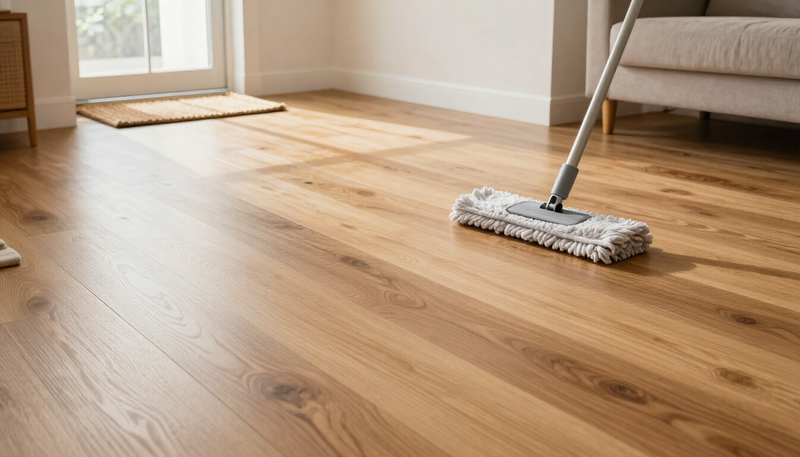
Daily and Weekly Floor Care
Improper cleaning causes more damage than normal wear.
What to do
- Sweep or dust mop regularly.
- Use manufacturer-recommended cleaners.
- Lightly dampen cloths, never soak them.
- Clean spills immediately.
What not to do
- Never damp mop with water.
- Never use steam cleaners.
- Never use oil soaps or wax on polyurethane finishes.
- Never let standing water sit.
Water deteriorates both the wood and the finish.
Acclimation: Why It Still Matters
Acclimation is mainly an installation issue, but homeowners should understand it because poor acclimation can cause problems for years. Solid wood must adjust to site conditions before it is installed. Engineered flooring is more stable but still sensitive to extremes. In short: take the wood out of its packaging, monitor moisture with a meter and hygrometer, and let it reach job-site equilibrium. The guiding principle is to err on the side of slight shrinkage rather than expansion, because filling small seasonal gaps is easier than repairing buckling.
Species Stability
Different species move differently. Hickory has a high tangential movement ratio, oak is more dimensionally stable, and wider planks move more than narrow strips. Wider boards also naturally cup slightly because of grain orientation. If you are choosing plank flooring, remember that wider means more seasonal movement.
Below-Grade Installations
Solid wood should not be installed below grade. Engineered flooring can be installed above grade, on grade, or below grade. Below grade includes basements, even walk-out ones, and slabs with four or more inches of earth above them. Engineered flooring performs better in variable humidity because of its layered construction.
The Importance of Moisture Barriers
Even if moisture levels are acceptable at installation, moisture can migrate later. Barriers protect floors long after the work is finished:
- 6 to 8 mil polyethylene in crawl spaces
- Heavy plastic film beneath slabs
- Felt paper between the subfloor and wood flooring
- Vapor barriers over concrete slabs
When Things Go Wrong
Inspectors investigating floor failures often find the same patterns: flooring installed before acclimation, HVAC not running, irregular nailing, and moisture readings that were never documented. In a typical failure, the subfloor reads 12 to 14% moisture while the flooring reads 8%, with no acclimation period. The result is cupping within weeks and buckling soon after. Blame then spreads between the general contractor, the retailer, and the installer, but it is the homeowner who suffers. The lesson is to ask questions before installation.
What to Ask Before Installation
- Has the building been closed in for 48 hours?
- Is the HVAC operational?
- Have wet trades dried completely?
- What are the subfloor moisture readings?
- What is the flooring moisture content?
- Is a vapor retarder being installed?
- How long will the flooring acclimate?
Documentation protects everyone.
Seasonal Expectations: What Is Normal
- Winter: small gaps between boards and a slight increase in creaking.
- Summer: boards expand, and minor cupping is possible in humid conditions.
Normal seasonal movement does not mean failure.
Long-Term Maintenance Strategy
- Control humidity. It is the single most important action.
- Protect entryways with mats, remove wet shoes, and avoid snow buildup.
- Use furniture pads to prevent finish damage.
- Trim pet nails, since scratches expose wood fibers.
- Recoat before the finish wears through. Do not wait until bare wood shows.
When to Call a Professional
Get a professional evaluation if boards buckle, cupping lasts for months, gaps stay open year-round, mold or odors appear, or boards detach from the subfloor. Early diagnosis prevents extensive damage.
The Philosophy of Wood Floor Ownership
The old saying claims that water and wood do not mix. In truth, wood and water are inseparable. Wood begins as a tree full of moisture, and even after milling, drying, finishing, and installation it keeps responding to its environment. A wood floor is not static, it is dynamic. When homeowners understand that its movement is natural and manageable, they can appreciate the character of their floors instead of fearing it.
Final Thoughts: Education Is Protection
A wood floor's longevity depends less on installation day and more on the decades that follow. Manage humidity, expect seasonal change, clean properly, watch for moisture sources, and act early when problems appear. Properly maintained, cracks close seasonally, cupping resolves with moisture control, the floor can be refinished many times, and the wood can last generations. Control the climate, clean properly, expect seasonal change, and your wood floor can truly last a lifetime.
Related Services
Hardwood Floor Services in Orland Park
Keep Reading
More Hardwood Floor Guides
- Understanding Wood & Moisture BehaviorWhy hardwood moves with the seasons, what is normal, and what is a warning sign.Read the guide
- Proper Job Site Preparation and Moisture ControlWhat happens before the first board goes down, and why it decides how the floor performs.Read the guide
- Precision Installation and Allowance for Natural MovementHow expansion gaps, fastening and layout let a hardwood floor move without damage.Read the guide
Contact
Questions About Your Floor? Call Us
Call 708-738-9681 for a free estimate, or request one online and tell us about your floor.